
The Costa del Sol property market remains healthy, but increasing supply and rising asking prices are making buyers more price-conscious. We look at why the market may simply be returning to more normal conditions.

Boom or bust?
The Costa del Sol property market is still busy. There is plenty of demand, properties are selling and selling prices are certainly not showing signs of collapse. But after several years of exceptional price increases, there are signs that the market is beginning to normalise. Residential property sales in Málaga province were down by just over 9% in the first quarter of 2026 compared with the same period in 2025.
That doesn't mean property prices fell by 9%, and it certainly doesn't mean that demand disappeared. It means that fewer properties changed hands. And when we look at that alongside increasing supply, slowing price growth and what we are actually seeing from buyers and sellers, the picture becomes interesting, and that should probably be welcomed rather than feared.
The first quarter of 2026 saw fewer property sales in Málaga province than the exceptionally strong first quarter of 2025. At the same time, asking prices continued to rise, although even that rate of increase is now slowing. Idealista's figures for Málaga province show advertised prices in August 2026 still 7.4% higher than a year earlier, but that compares with annual growth of around 14% in September 2025.
So perhaps the question isn't whether the market is going up or down. It is more whether asking prices and buyers' willingness to pay those increased prices are moving at different speeds.
Asking prices aren't necessarily evidence of value
Imagine there are five reasonably comparable properties for sale at around €900,000.
A new seller looks online and understandably concludes that their property must also be worth around €900,000. They may even think it should be €925,000 because they have repeatedly been told that property prices are rising.
An estate agent coming to recommend an asking price sees the same evidence, but there is one very important question:
How long have those five properties been for sale?
If they have all been sitting on the market at around €900,000 for four or five months without selling, they aren't necessarily evidence that €900,000 is achievable.
In truth, this may be evidence that €900,000 is the price at which they won't sell.
Yet those asking prices remain on the property portals. They influence the next seller, the next estate agent and potentially the automated valuation systems that use advertised properties as part of their calculations.
The failure of the €900,000 properties to sell can perversely help create the next €925,000 asking price.
Estate agents are part of this too
It would be very easy for an estate agent to blame unrealistic asking prices entirely on sellers, but that wouldn't be fair.
When we visit a property, we aren't simply providing a valuation. We are normally recommending an asking price, and that meeting is also, inevitably, a pitch for the owner's business. Suppose I genuinely believe that buyers are likely to value a particular property at around €825,000, but there are five competing properties advertised at €900,000. If I recommend €825,000 while several other agents recommend €900,000 or €925,000, there is a very good chance that I will simply walk away without the instruction. I might therefore recommend testing the market at €875,000 or €895,000. I would explain my concerns, position the property below much of the competition and see how buyers react.
There is nothing wrong with testing the market. The important thing is to react to the result of the test.
A healthy market doesn't mean everything will sell at every price
I can still remember enough economics from school to understand the basic relationship between supply, demand and price.
Demand for Costa del Sol property can remain strong. But if prices increase, fewer of those buyers will be prepared to transact at the higher level. If, at the same time, the amount of property available increases, buyers have more choice. That doesn't mean the market is unhealthy. It simply means that sellers are competing harder for the available demand.
A healthy property market does not mean that every property will sell at every price. This is where a simple supply-and-demand graph probably explains the situation better than several paragraphs of economics.
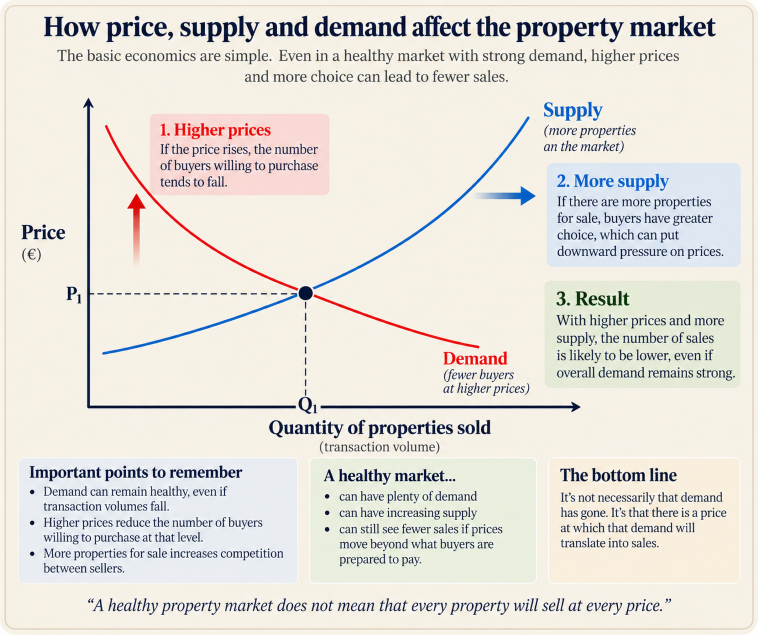
Demand doesn't have to disappear for sales to slow. If asking prices increase, fewer buyers will transact at that price. If the supply of competing properties also increases, buyers have more choice. A busy and healthy market can therefore coexist with properties that take longer to sell because their asking prices are too high.
In a rapidly rising market, time could solve the problem
One reason this adjustment may take a while is that sellers have become accustomed to a market in which waiting often worked.
If a property was put on the market 10% too high during a period of very rapid price growth, six or twelve months later the market might have caught up with the asking price. Eventually the property sold, which could create the impression that the original asking price had been correct all along. Perhaps it wasn't. The market had simply caught up.
In a more normal market, if you start 10% too high, six months later you may still be too high. Twelve months later you may still be too high. In a gently falling market, the market could actually be moving further away from you.
Property markets are rather like ocean liners. Once they have gathered momentum, you can't stop them on a sixpence and turn them around. (Younger readers may need to ask Google what a sixpence was.)
Seller expectations take time to change. Asking prices take time to change. Estate agents' recommendations take time to change. But eventually they do.
Sometimes no viewings is the market talking
We are already having conversations with some sellers where we have to say that we aren't receiving the level of enquiry we would expect, or that the property isn't generating the reaction we had hoped for. Those aren't particularly enjoyable conversations for either party.
They can be even more difficult when an owner is sitting in another country reading reports about a booming Costa del Sol property market. But if a properly marketed property in a busy market isn't receiving enquiries or viewings, that is information. It doesn't automatically prove that the asking price is wrong, but it certainly gives us a reason to look at it.
An absent seller relies particularly heavily on their estate agent to tell them what is really happening, rather than simply what they would like to hear. And that requires honesty on both sides. An estate agent has to be prepared to have an uncomfortable conversation. But a seller who wants honest advice also has to allow their agent to give them an answer they may not particularly like.
Testing the market is a strategy. Waiting indefinitely isn't.
There is nothing wrong with wanting to try a slightly higher asking price. If it were my property, I might well want to do exactly the same thing. But if we agree that we are testing the market, we need to listen to the result.
Are we receiving enquiries? Are people arranging viewings? What are they saying? Are we receiving offers? What are buyers choosing instead? And what is happening to those apparently comparable properties that were already on the market?
The seller's own circumstances matter too. Someone who genuinely doesn't care whether they sell this year or in three years can afford to take a very different approach from someone who would really like to have it completed within six months. That is something worth discussing honestly with your estate agent.
Perhaps normalisation is exactly what the market needs
One encouraging development is that more estate agents are now talking openly about what they are seeing.
Social media has created a forum for conversations that simply didn't exist during earlier property cycles. Agents can compare experiences and acknowledge that increasing stock, greater buyer choice and unrealistic asking prices don't mean that the Costa del Sol property market is suddenly in trouble. They may simply mean that it is becoming more normal.
Nobody can guarantee what property prices will do next, and an unexpected economic event can always change the picture. But recognising changing conditions and reacting to them early should make adjustment easier. After several extraordinary years, perhaps we don't need another boom, and we certainly don't need a crash.
We need a healthy market in which sellers want to sell, buyers want to buy, and the price allows the two to meet.
Test the market by all means. But listen to what it tells you.
If you would like to discuss the sale of your own property without obligation, then please do not hesitate to give us a call on (0034) 952 90 52 00, WhatsApp us, or email info@michael-moon.com. We are here to help.