
There is no hidden "correct" price. The right price is the point where a willing buyer and a willing seller are both comfortable making the transaction. The article explores the psychology behind reaching that point, rather than trying to produce a pricing formula.
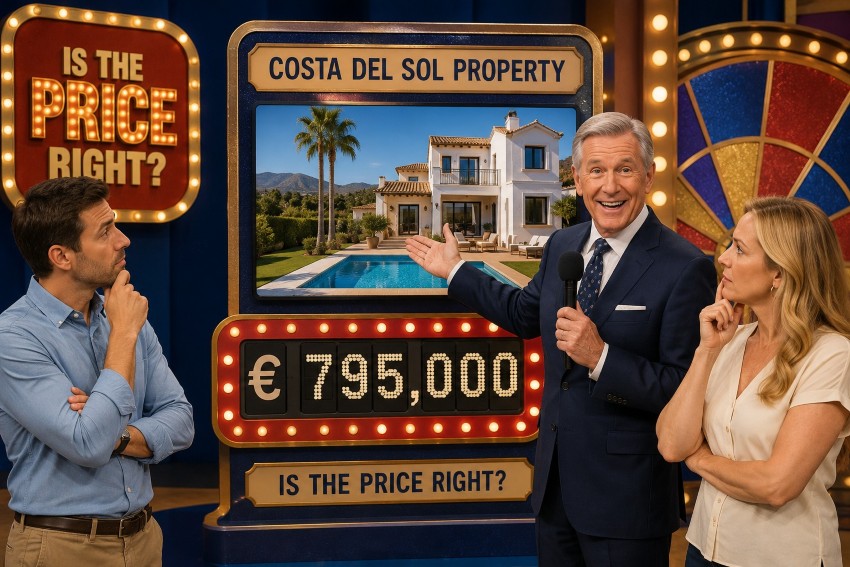
How do I know when the price is right?
If you have ever sold a property on the Costa del Sol, you'll probably remember wondering whether your asking price was right. If you've ever bought one, you've almost certainly wondered whether you could have bought it for less.
Whilst deciding whether the price is right is not a game show, the truth is that buyers and sellers often approach exactly the same property from completely different directions.
One of the first questions buyers ask us is often not about the property itself, but, "What will they take for it?" It's a perfectly understandable question, but it also reveals something important. Most buyers aren't really trying to decide what a property is worth. They're trying to work out the least they would have to pay while still being able to buy it.
Buyers and sellers are therefore facing two completely different challenges.
There is no right or wrong price
We often talk about a property's value as though it is a fixed figure that can be calculated precisely. In reality, pricing a property is as much an art as it is a science.
Comparable sales, market conditions and professional valuations are all valuable, but at the end of the day, the value is simply the price that a willing buyer is prepared to pay to a willing seller at that particular moment. That can change from one week to the next.
A buyer relocating for work may have a deadline and be prepared to pay more than someone who is simply browsing the market. Equally, a seller who is already committed to another purchase may place more value on certainty than squeezing out every last euro.
The property market isn't static. It changes as people's circumstances change.
Every negotiation begins with uncertainty
Throughout the years I have been involved in buying and selling property, one thing I have noticed is that both buyers and sellers tend to question themselves.
If a buyer makes an offer that's accepted immediately, their first thought is often, "Could I have bought it for less?"
On the other hand, when a seller receives an offer at or close to the asking price, it's not unusual for them to wonder whether they could have asked for more.
Neither reaction is unusual or unreasonable. Neither side knows exactly where the other person's limit is, so both are left wondering whether they could have achieved a better result. In many ways, that's simply the nature of negotiation.
Don't assume another opportunity will come along
Years ago, I remember a buyer contacting us after a property had been sold. He was disgruntled because he had been interested in the property and wanted to know why he hadn't been informed that somebody else was also showing interest.
I reminded him that when he had made his offer, around 20% below the asking price, the vendors had refused it. At the time, we had explained that there was a great deal of interest in the property and that we were confident somebody would make an offer much closer to the asking price. In response, he had decided to walk away.
His reply was very simple: "Well, I didn't believe you."
The lesson isn't that buyers should always believe the estate agent. The point is that if you genuinely want a property, don't assume there will always be another opportunity or that another buyer won't come along prepared to pay a reasonable price.
Exactly the same principle applies to sellers. When discussing an asking price, we often suggest choosing a figure that, if the right buyer offers it during the first week, your reaction is, "Great, let's take the money and run," rather than, "Perhaps we should have asked for more."
Sometimes you simply happen to meet the right buyer very quickly. If you let that buyer walk away because you assume somebody better will appear next week, you may eventually find yourself accepting a lower offer several months later. There are no guarantees.
Listening to the market
None of this means you have to accept the first offer you receive.
Every owner has a figure they are prepared to accept, and that has to remain their decision. However, it is important to listen to what the market is telling you. If your property generates plenty of viewings but no offers, it's worth asking why. If you receive a regular flow of offers but they all stall at a similar level, the market may be telling you that buyers see the property's value differently from you.
This doesn't mean you have to reduce your price immediately. It does mean the market is giving you valuable information. You don't have to act on it straight away, but it's worth listening.
Selling is emotional as well as financial
One thing that's often overlooked is that selling a home is not purely a business transaction.
If you've owned the property for twenty years, watched your children grow up there and created countless memories, you're not simply selling bricks and mortar. You're saying goodbye to a chapter of your life. That is why selling can be emotional, even when it's absolutely the right thing to do.
In my experience, one of the biggest challenges isn't deciding on the asking price. It's preparing yourself mentally to let the property go. Once you've reached that point, you're far more likely to recognise a genuinely good offer when it comes along instead of constantly wondering whether something better may appear next month.
The right price is the one you are happy to accept
There isn't a perfect asking price that guarantees the best possible result. Pricing a property will always involve judgement, experience and a degree of uncertainty.
What matters most is choosing a figure that you are genuinely happy to accept if the right buyer comes along, while remaining realistic enough to listen if the market tells you something different. The best negotiations often leave both buyer and seller wondering whether they could have achieved slightly more. That's perfectly normal. The important thing is that both sides reach an agreement they are genuinely happy to make. That is the point at which the property's value has been established.
If you're trying to decide whether the price of your property is right, an experienced estate agent should be able to explain how today's buyers are likely to see it, while also listening carefully to what you hope to achieve.
The right asking price isn't about proving who's right. It's about finding the point where the right buyer and the right seller are both comfortable moving forward.
If you'd like to discuss your own property, we're always happy to share our thoughts, explain our reasoning and help you decide what approach feels right for you. Call us on (0034) 952 90 52 00, WhatsApp us, or email info@michael-moon.com.